
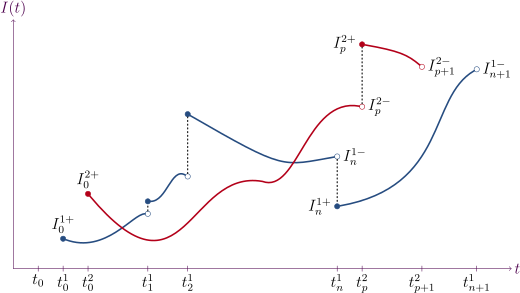
An important task 1 of an investment portfolio manager is to report on the performance of not only a portfolio as a whole, but also of its constituent investment instruments. For a portfolio comprised of a single instrument into which a single lump sum cash injection is made, reporting on performance is trivially easy. But life is seldom easy. Usually, multiple disparate instruments make up an investment portfolio, and cash injections and ejections are a mix of ad hoc lump sum and regular deposits and withdrawals. Under such a regime of sporadic and uncorrelated buy/sell transactions, reporting on performance is indeed not trivial.
Herein, then, I introduce two numerical measures of performance. The measures are specially taylored to account for such real-world investing regimes. The first measure, dubbed the effective long growth rate, accommodates cash injections and ejections on a set of investments of arbitrary size and at arbitrary times. The effective long growth rate is formulated as a composite of exponential growth rates. It is an inherently nonlinear measure, weighted by transaction size and by the lapsed time between adjacent transactions. The second measure, dubbed the spot proportional change, accounts for the deleterious effect of transaction costs on an investment's performance.
These two new performance measures have been incorporated in the author's pkInvest portfolio management software.
Download PDF measuring-investment-growth.pdf (425 KB)